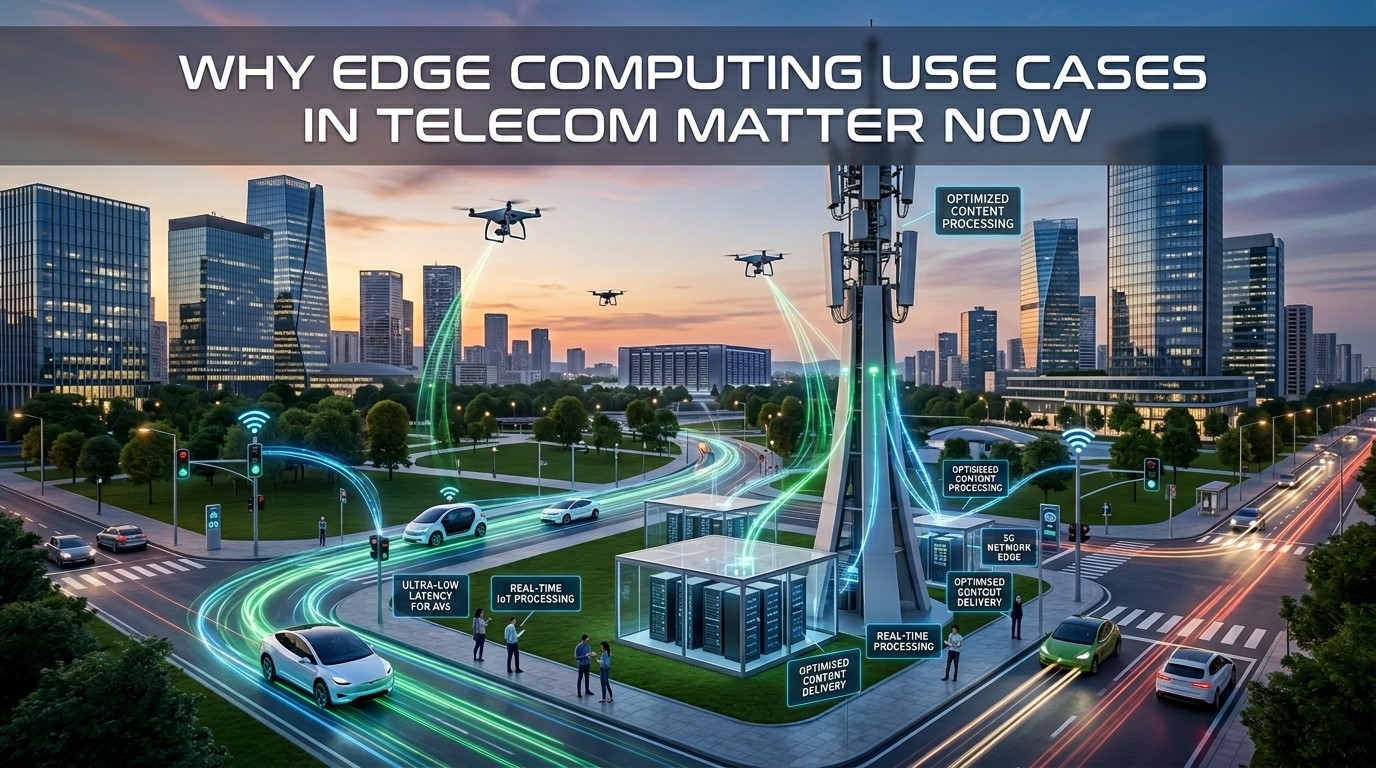
Edge computing use cases in telecom are becoming critical because operators need lower latency, better bandwidth efficiency, faster decisions, and more reliable experiences close to users and devices.
Edge Computing Use Cases are no longer a future concept for telecom; they are becoming a practical response to latency-critical and bandwidth-hungry services that need to run closer to the customer. ETSI’s MEC work describes the RAN edge as a place with proximity, low latency, and high bandwidth, and Ericsson says CSP edge computing is key for latency-critical and bandwidth-hungry 5G use cases.
Edge Computing Use Cases matter now because the network itself has become part of the product experience. In 5G and beyond, Ericsson describes the mobile network as a platform for innovation, not just transport, which means applications increasingly rely on real-time compute near the edge to stay responsive and useful.
Edge Computing Use Cases are also changing because telecom operators want new service value, not only better throughput. ETSI says MEC can support business transformation, technology integration, and industry collaboration, while also enabling new markets such as connected vehicles, industry automation, augmented reality, gaming, and IoT services.
Edge Computing Use Cases in telecom are therefore both technical and commercial. Technically, they reduce distance between users and compute. Commercially, they create room for new products, partner ecosystems, and premium service tiers that would be difficult to justify if everything stayed deep in a central cloud.
What edge means in telecom
Edge Computing Use Cases in telecom usually refer to processing, storage, and application logic that sit nearer to the radio access network or service delivery point. ETSI’s MEC materials define the environment as the mobile network edge and emphasize interoperability, deployment, and real-time context exposure as key goals.
Edge Computing Use Cases differ from ordinary cloud use because they are designed for short feedback loops. If a camera feed, gaming session, vehicle signal, or industrial sensor has to wait too long for a remote server, the experience becomes slower and less predictable. That is why edge infrastructure exists: it shortens the path between event and response.
Edge Computing Use Cases are especially relevant when the application needs local awareness. ETSI notes that MEC can expose real-time radio network and context information, which is powerful for services that need to know location, load, or nearby conditions as they happen. That changes edge from simple hosting into a smarter network capability.
Edge Computing Use Cases also fit the operator’s role because telecom providers already own the access network and have operational reach close to users. Ericsson’s materials highlight edge at the CSP network as a way to deliver reduced latency, higher performance, and improved data security and privacy. That makes the operator edge more than a convenience; it becomes a strategic layer.
The main telecom drivers
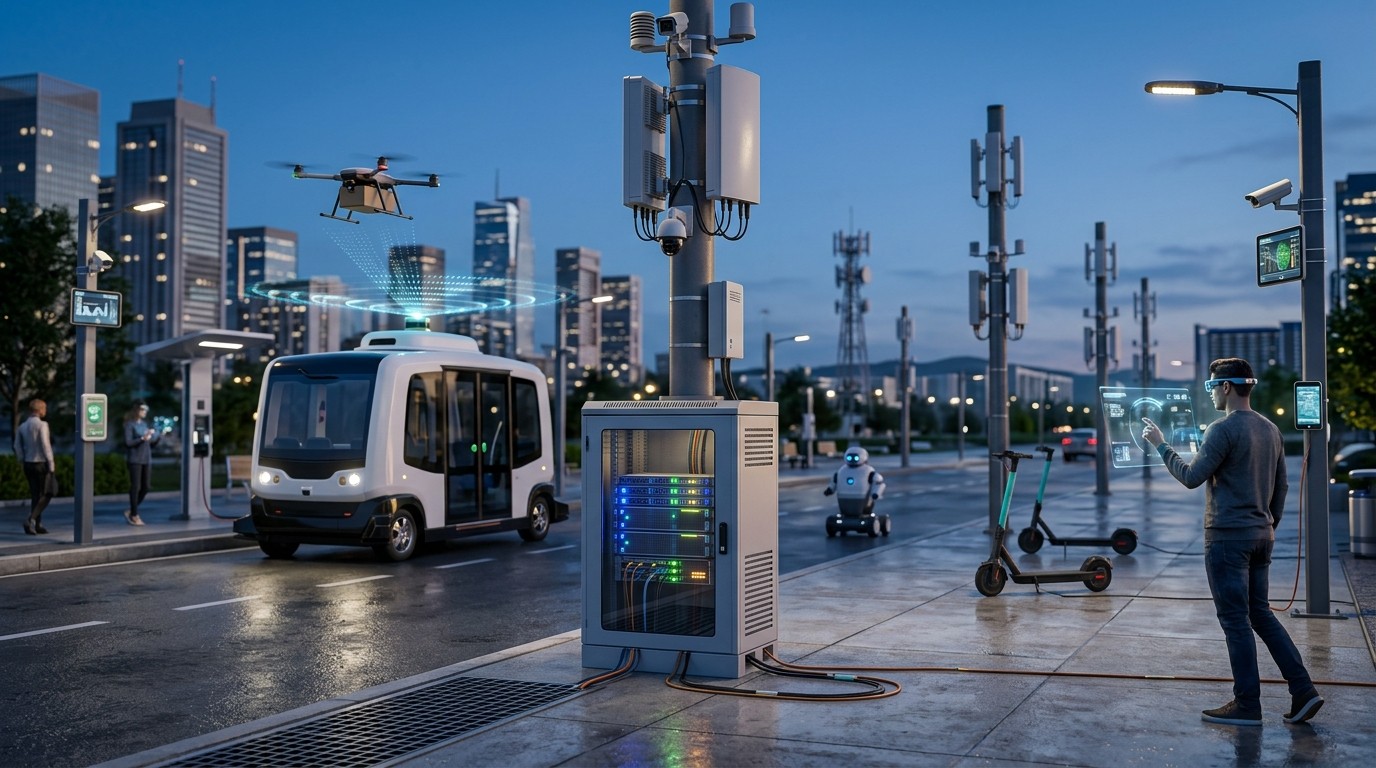
Edge Computing Use Cases are growing because modern mobile services are more demanding than the first wave of internet apps. ETSI’s white paper says MEC supports e-Health, connected vehicles, industry automation, augmented reality, gaming, and IoT services, all of which benefit from proximity and speed.
Edge Computing Use Cases also benefit from the economics of service delivery. Ericsson says the cost of building and operating CSP edge compute is only marginally more than large-scale data centers, and can be significantly less than enterprise on-premises compute solutions. That cost structure helps explain why telecom operators are willing to invest now rather than wait.
Edge Computing Use Cases are getting stronger because the ecosystem around 5G is maturing. Ericsson says immersive use cases had been held back by the development of the wider ecosystem, including networks, devices, and applications, but that value from edge computing grows as that ecosystem matures. In other words, the timing is now better than it was before.
Edge Computing Use Cases matter because the mobile network can support new forms of innovation when applications and network intelligence interact more closely. Ericsson describes 5G as a platform for innovation, which helps explain why the edge conversation is not only about latency, but about the kinds of experiences telecom can enable going forward.
High-value use cases already leading the shift
Edge Computing Use Cases show up first where latency and bandwidth are painful enough to limit the experience. ETSI’s MEC work highlights IoT, V2X, drones, gaming, video analytics, location services, augmented reality, optimized local content distribution, and data caching. These are not abstract categories; they are the kind of services that change once compute is moved closer to the user.
Edge Computing Use Cases in augmented reality are compelling because the user experience depends on immediate response. Ericsson’s 5G Advanced use-case material includes AR and describes cloud-rendered content and multi-modal AI interactions, which are the kind of experiences that benefit from short round-trip times and high throughput.
Edge Computing Use Cases in gaming are equally important because delays can ruin interaction quality. ETSI explicitly lists gaming among MEC use cases, and its white paper earlier identified gaming as one of the innovative markets that MEC can support. For players, that means less lag; for operators, it means a stronger reason to build local compute capacity.
Edge Computing Use Cases in video analytics are another natural fit because cameras often generate data faster than a central cloud can handle efficiently. ETSI lists video analytics as a use case, and local processing helps reduce backhaul pressure while improving response time. That is important for smart cities, retail, transport hubs, and industrial monitoring.
Edge Computing Use Cases in V2X and automotive are especially sensitive because safety and coordination depend on rapid signals. ETSI lists V2X among the main categories, and Ericsson’s 5G Advanced material includes automotive and transport, including enhanced intersection safety, connected autonomous vehicles, automated valet parking, and road infrastructure operations.
Edge Computing Use Cases also matter in drones and location-based services. Ericsson describes connected drones and connected robots as part of location-based services, and ETSI includes drones and location services in its MEC list. These applications need precise, local, real-time information, which is exactly what edge architecture is designed to support.
Why operators care about platform value
Edge Computing Use Cases are attractive to operators because they create a new commercial layer above connectivity. ETSI says the MEC environment can accelerate access to content and applications, increase responsiveness, and deliver locally relevant content directly where users connect, which also limits ingress bandwidth to the core and cloud. That is a direct operational and business benefit.
Edge Computing Use Cases can also unlock ecosystem partnerships. Ericsson says edge computing opens opportunities in virtual and hybrid 5G private networks, and its Local Packet Gateway offering is positioned to support high bandwidth and low latency use cases. That suggests the operator edge is not just a platform for one app category; it is a shared foundation for multiple service models.
Edge Computing Use Cases are commercially interesting because they can support enterprise service innovation. Ericsson emphasizes orchestration and exposure, which means operators can expose network capabilities to application ecosystems rather than merely acting as transport providers. That is a major psychological shift for telecom organizations that historically sold connectivity in a simpler way.
Edge Computing Use Cases are also tied to trust. Ericsson says deploying compute resources at the edge of a CSP mobile network brings reduced latency, higher performance, and improved data security and privacy. For enterprise buyers, that combination matters because many workloads need not only speed, but confidence about where data is processed and how quickly it can be acted on.
Planning and product strategy
Edge Computing Use Cases should be chosen according to measurable pain, not hype. If a use case cannot clearly benefit from lower latency, local context, bandwidth savings, or deterministic response, then it may not justify edge placement. The strongest cases are the ones where central cloud delay is already a visible problem.
Edge Computing Use Cases are easier to prioritize when teams separate consumer and enterprise demand. Consumer-facing areas like gaming, AR, and live broadcasting often benefit from performance perception, while enterprise scenarios such as industrial IoT, smart cameras, and V2X often benefit from operational control and safety. ETSI and Ericsson both show that MEC spans both worlds.
Edge Computing Use Cases can also influence product discovery and market planning. App Market Research becomes useful when teams measure whether low-latency services change adoption, retention, or conversion in a region. The goal is to connect edge capability with user behavior and willingness to pay.
Teams often describe the same shift as Telecom Edge Computing when they focus on network-side deployment, and Smart Edge Computing is the practical idea of placing intelligence where it can respond faster without overloading the core.
In practice, Edge Computing Use Cases are easiest to justify when the service must feel instant to the user.
Edge Computing Use Cases may even help shape experimentation for companion products such as a Game Market Research App. If gaming performance, cloud rendering, or regional latency patterns change the user experience, the research layer should capture those shifts so the team can understand where edge deployment creates real commercial lift.
Telecom edge architecture in plain language
Edge Computing Use Cases depend on a simple idea: move computation closer to where the data is born. In telecom, that usually means closer to the radio access network or at a service edge where local decisions can happen quickly. ETSI’s MEC papers frame the edge as a location of proximity, low latency, high bandwidth, and real-time network context.
Edge Computing Use Cases become more effective when orchestration is built in. Ericsson says service orchestration is central to unlocking enterprise innovation, because applications need a way to reach the right compute point and use the right network capabilities. Without orchestration, the edge can become fragmented and hard to manage.
Edge Computing Use Cases also rely on interoperability. ETSI’s MEC specification explicitly says its purpose is to promote interoperability and deployments, which is essential because telecom edge ecosystems involve operators, vendors, application developers, and enterprise customers. A usable edge platform needs shared expectations, not just fast hardware.
Edge Computing Use Cases are stronger when the system exposes context. ETSI notes that MEC can expose real-time radio network and context information, which enables better decisions for applications that need current location, load, or network conditions. That contextual layer is what makes edge feel “smart” rather than merely “near.”
Where telecom meets industry transformation
Edge Computing Use Cases are especially compelling in industrial environments because industrial IoT often needs low latency and trusted computing. ETSI says central clouds are often not an option for those scenarios, leaving edge cloud as the viable option. That is a clear signal that telecom edge is becoming part of industrial infrastructure, not just a network accessory.
Edge Computing Use Cases in factories, logistics, ports, and campuses often revolve around vision systems, sensors, robotics, and control loops. Ericsson’s 5G Advanced material includes connected robots and connected drones, showing how telecom edge can support systems that need real-time precision and mobility together. That combination matters because industrial environments are both dynamic and time-sensitive.
Edge Computing Use Cases also align with private network growth. Ericsson’s edge page frames CSP edge as a way to support virtual and hybrid 5G private networks for high bandwidth and low latency use cases. That creates a strong overlap between telecom, enterprise networking, and localized application delivery.
Edge Computing Use Cases are therefore not only about public networks or public consumer services. They are a bridge between enterprise operations and mobile infrastructure, which is why operators see edge as a path to relevance in areas where performance and proximity are both non-negotiable.
Why the business case is stronger now
Edge Computing Use Cases are more compelling now because the ecosystem has moved from concept to deployment. ETSI continues publishing MEC use-case and requirements work, and its working group lists current use cases including IoT, V2X, drones, gaming, video analytics, location services, augmented reality, optimized local content distribution, and data caching. That breadth shows the field has matured beyond a single niche.
Edge Computing Use Cases also benefit from market timing. Ericsson’s Mobility Report article says edge computing is key to enabling latency-critical and bandwidth-hungry 5G use cases and represents significant growth potential for CSPs. That is a strong signal that operators are not looking at edge as a side project; they are looking at it as a growth vector.
Edge Computing Use Cases are now easier to justify because the cost and capability equation has become clearer. When edge compute can offer lower latency than a central cloud and still be economically reasonable compared with enterprise on-premises alternatives, the value proposition becomes easier to defend to buyers and to internal stakeholders.
Edge Computing Use Cases are also being helped by 5G Advanced. Ericsson’s 5G Advanced page shows use cases such as AR, big events, RedCap, automotive and transport, public safety, positioning, and live broadcasting, all of which benefit from more deterministic performance. That is a practical sign that telecom edge is moving from theory into product roadmaps.
How teams should think about adoption
Edge Computing Use Cases should be selected with a simple filter: does the application need speed, locality, context, or reduced backhaul enough to justify edge placement? If yes, then the case may be a strong candidate. If not, the central cloud may still be the better fit. Not every workload needs to be pushed outward.
Edge Computing Use Cases should also be measured by outcome. Faster response, better user experience, stronger safety, reduced bandwidth, and more local control are all meaningful outcomes. A use case that looks technically impressive but does not improve a real KPI may not survive contact with budgets, so the most durable projects are the ones with visible business value.
Edge Computing Use Cases should be planned with the broader stack in mind. Networks, orchestration, APIs, application ecosystems, and compliance all matter. Ericsson’s materials emphasize orchestration and network exposure, while ETSI emphasizes interoperability and deployment requirements. Together, those sources show that successful edge deployments need both technical and organizational coordination.
Edge Computing Use Cases also need to be explained in simple language to non-technical stakeholders. Many decision makers care about why an edge project matters now, not how every packet moves. When the benefits are framed around latency, user experience, trust, and revenue potential, the business case becomes easier to understand and easier to fund.
A practical summary of where value appears
Edge Computing Use Cases tend to create value in four main places. First, they reduce latency, which improves responsiveness. Second, they conserve bandwidth by keeping data local when it makes sense. Third, they expose context that improves decisions. Fourth, they create room for new services and partnerships in telecom ecosystems. These benefits appear across consumer, enterprise, and public-safety contexts.
Edge Computing Use Cases are strongest when all four benefits line up. A connected vehicle or industrial camera feed may need low latency, local processing, better backhaul efficiency, and trusted handling all at once. That is why the edge conversation is so important now: it is not one feature, but a stack of advantages that reinforces itself.
Conclusion
Edge Computing Use Cases matter now because telecom networks are becoming platforms for real-time services, not only pipes. ETSI and Ericsson both show that MEC and CSP edge computing support low-latency, bandwidth-hungry workloads such as gaming, AR, V2X, drones, video analytics, industrial IoT, and private networks. The business case is stronger because these workloads need speed and locality that central clouds cannot always provide. When operators combine proximity, orchestration, and network intelligence, edge becomes a way to improve experience and create new revenue paths in telecom. It also gives operators a clearer path to differentiation and long-term relevance.
Frequently Asked Questions (FAQ)
1. What are Edge Computing Use Cases in telecom?
Edge Computing Use Cases in telecom are services that run closer to the radio access network or network edge so they can respond faster, use less backhaul, or access local context more effectively.
2. Why are Edge Computing Use Cases important now?
They matter now because 5G and beyond support latency-critical and bandwidth-hungry services, and operators can use edge to improve responsiveness and create business value.
3. Which telecom services benefit most?
IoT, V2X, gaming, video analytics, augmented reality, drones, location services, and data caching are clear examples listed by ETSI and Ericsson.
4. Is edge only useful for consumers?
No. Edge Computing Use Cases are strong for consumer, enterprise, and industrial environments, especially where low latency, safety, or local processing matters.
5. How does MEC relate to edge?
ETSI’s MEC framework is the telecom standards context for edge computing in mobile networks, with interoperability and deployment as core goals.
6. Why do operators care so much?
Because edge can reduce latency, improve performance, support privacy, and create a platform for enterprise innovation and new revenue models.
7. What role does 5G Advanced play?
5G Advanced expands services that benefit from edge, including AR, live broadcasting, automotive, public safety, and precise positioning.
8. Is edge always better than cloud?
No. If a workload does not need proximity, low latency, or local context, central cloud may still be the better fit.
9. Can edge help with market planning?
Yes. App Market Research can use edge-related performance signals to understand whether low latency changes adoption, engagement, or retention in a market.
10. What is the clearest takeaway?
The takeaway is that Edge Computing Use Cases are becoming central to telecom because the network now needs to support real-time experiences, not just connectivity.